Ankle Pain: Causes, Symptoms and Treatment Options
Written and medically reviewed by
Dr Dinesh Sirisena
Consultant in Sports, Exercise & Musculoskeletal Medicine
Triaxis Sports & Joint Clinic
Ankle pain can result from injuries or conditions affecting the ligaments, tendons, muscles, bones, joints or nearby nerves. Common causes include ankle sprains, tendon problems, overuse injuries and arthritis. Many ankle problems can be managed without surgery, although treatment depends on the cause and severity. Clinical assessment, activity modification, rehabilitation and appropriate imaging or procedures may be considered when necessary.

Key Points at a Glance
- Ankle pain can develop suddenly after an injury or gradually through repetitive activity.
- Ankle sprains are a common cause, particularly during sports involving running, jumping or rapid changes of direction.
- Pain location can provide useful clues, but symptoms alone may not identify the exact cause.
- Ligaments, tendons, bones, cartilage, joints and nerves can all contribute to ankle symptoms.
- Many ankle conditions can be managed without surgery.
- X-rays, MRI or musculoskeletal ultrasound may be considered depending on the suspected condition.
- Rehabilitation commonly focuses on mobility, strength, balance and gradual return to activity.
- Persistent pain, repeated ankle instability or difficulty bearing weight may warrant medical assessment.
What causes ankle pain?
Ankle pain can have many causes, including ligament sprains, tendon injuries, joint problems, fractures, overuse and arthritis. The location and circumstances of the pain can help narrow down the possibilities, but a clinical examination is often needed when symptoms are persistent, severe or associated with swelling, instability or difficulty walking.
The ankle is exposed to considerable force during walking, running, jumping and changes of direction. Symptoms may therefore begin after a clear injury, such as rolling the ankle, or develop gradually after repeated loading.
Common causes include:
- Ankle ligament sprains
- Achilles tendinopathy
- Peroneal tendon problems
- Posterior tibial tendon problems
- Ankle impingement
- Osteoarthritis
- Cartilage or osteochondral injuries
- Stress injuries
- Fractures
- Muscle injuries
- Nerve-related pain
The cause matters because treatment for a ligament injury may differ significantly from treatment for tendon, joint or nerve-related pain.
Where is ankle pain usually felt?
Ankle pain may occur on the outside, inside, front or back of the ankle. The location can provide clues about which structures may be involved. However, several tendons, ligaments, joints and nerves are located close together, so pain location alone does not provide a definite diagnosis.
Outside of the ankle: lateral ankle ligaments and peroneal tendons are common considerations.
Inside of the ankle: symptoms may involve the medial ligaments, posterior tibial tendon or other nearby structures.
Front of the ankle: joint irritation or ankle impingement may cause discomfort, particularly during movements that bring the shin forward over the foot.
Back of the ankle: the Achilles tendon is a common source of symptoms.
Pain may also occur deeper within the joint or spread towards the foot or lower leg.
Why does my ankle hurt when I walk or run?
Ankle pain during walking or running may occur when a joint, tendon, ligament, bone or other structure is sensitive to loading. A recent increase in running distance, change in footwear, previous ankle injury or altered strength and movement may contribute. Persistent symptoms should be assessed rather than simply exercised through.
Running repeatedly loads the ankle and surrounding tissues. This is normally well tolerated, but symptoms can develop when the demands placed on the body change.
Examples include:
- Increasing running distance too quickly
- Introducing hill or speed training
- Returning to sport after a break
- Changing playing surfaces
- Previous ankle sprains
- Reduced calf strength
- Limited ankle movement
- Inadequate recovery
The aim of assessment is not simply to identify what hurts, but also to understand why the area may have become sensitive.
What structures make up the ankle?
The ankle is formed by bones, joints, ligaments, tendons, muscles and nerves working together to provide movement and stability. Because these structures are closely connected, ankle pain may arise from several different tissues, making clinical assessment important when symptoms do not settle as expected.
The main ankle joint is formed by the tibia and fibula of the lower leg meeting the talus bone.
Ligaments stabilise the ankle. On the outside, the lateral ligament complex is commonly injured during an ankle sprain.
Several important tendons also pass around the ankle, including:
- Achilles tendon
- Peroneal tendons
- Posterior tibial tendon
- Flexor tendons
- Extensor tendons
Muscles in the calf and lower leg help control ankle and foot movement, while nerves provide sensation and help activate these muscles.
Who is more likely to develop ankle pain?
Anyone can develop ankle pain, although risk can increase with sports participation, repetitive activity, previous ankle injuries and sudden changes in training. Certain joint, tendon or medical conditions may also contribute. A previous ankle sprain can be particularly relevant when someone experiences repeated instability or recurrent symptoms.
Activities commonly associated with ankle injuries include:
- Football
- Basketball
- Netball
- Badminton
- Tennis
- Running
- Trail running
- Hiking
- Rugby
- Dance
Sports involving jumping, landing and rapid changes of direction can place particular demands on the ankle.
However, ankle pain is not limited to athletes. It can also occur during everyday activities or develop gradually without a single identifiable injury.
Can ankle pain heal without surgery?
Many causes of ankle pain can be managed without surgery. Depending on the diagnosis, treatment may include education, temporary activity modification, progressive exercise and rehabilitation. Surgery may be considered for selected injuries or conditions, particularly where there is significant structural damage, persistent instability or symptoms that have not responded to appropriate conservative management.
For example, many uncomplicated ankle sprains can be managed through progressive rehabilitation.
Treatment should be based on the actual diagnosis rather than assuming that persistent pain means surgery is necessary.
Rehabilitation may focus on restoring:
- Comfortable movement
- Calf and ankle strength
- Balance
- Coordination
- Confidence during movement
- Sport-specific function
How long does ankle pain usually last?
Recovery time depends on the cause and severity of ankle pain. Mild injuries may improve relatively quickly, while more significant ligament, tendon, cartilage or bone injuries can take longer. Recovery should therefore be guided by symptoms, strength and function rather than by a fixed timeline alone.
A minor ankle sprain and a significant ligament injury should not be expected to recover at the same rate.
Other factors influencing recovery may include:
- Severity of injury
- Previous ankle problems
- Activity requirements
- Strength and mobility
- Rehabilitation progress
- Sporting demands
- Associated injuries
For athletes, being able to walk comfortably does not necessarily mean the ankle is ready for running, jumping or rapid changes of direction.
How is ankle pain diagnosed?
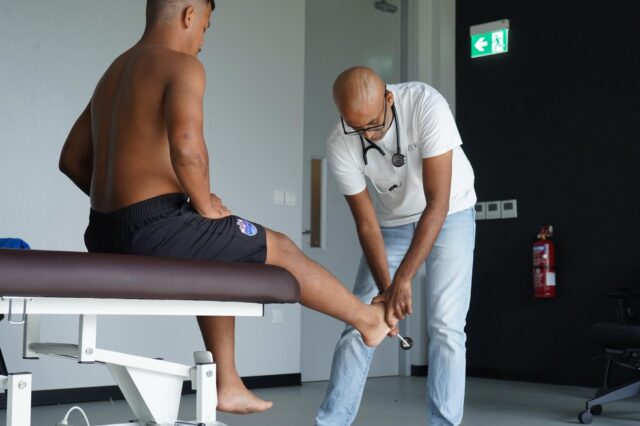
Ankle pain is usually assessed through a medical history and physical examination. The clinician may examine where the pain occurs, how the symptoms started, ankle movement, strength, swelling, stability and functional movements. Imaging may then be considered when it is likely to provide useful additional information.
Assessment may include:
- How and when the pain started
- Previous ankle injuries
- Location of tenderness
- Swelling or bruising
- Ankle range of motion
- Ligament stability
- Tendon function
- Muscle strength
- Balance
- Walking, running or sport-specific movement
Symptoms involving numbness, tingling or unusual weakness may also require assessment of nearby nerves.
Do I need an X-ray, MRI or ultrasound for ankle pain?
Not everyone with ankle pain requires imaging. The choice depends on the injury, examination findings and suspected diagnosis. X-rays are useful for assessing bones and certain joint changes, MRI provides detailed information about many internal ankle structures, and musculoskeletal ultrasound can dynamically assess selected tendons, ligaments and other soft tissues.
X-ray
An X-ray may be considered when a fracture or significant bone or joint problem is suspected.
MRI
MRI can provide detailed images of:
- Ligaments
- Tendons
- Cartilage
- Bone
- Joint structures
- Some soft-tissue injuries
Musculoskeletal ultrasound
Sports or musculoskeletal ultrasound is often a very useful initial assessment for ankle pain. It uses no radiation, can be performed at the point of care, and is well suited to examining the tendons and many of the ligaments around the ankle. It can help identify structural problems such as ligament tears, ankle joint swelling and tendinopathy.
A particular strength of ultrasound is that it also allows a functional, or dynamic, assessment. Because the ankle can be scanned while it moves, structures can be observed under load and in real time, which can add useful information that static images may not provide.
Imaging findings should always be interpreted alongside the patient’s symptoms and clinical examination.
What treatment options are available for ankle pain?
Treatment depends on what is causing the ankle pain, its severity and the individual’s activity requirements. Management may include education, activity modification, exercise therapy and rehabilitation. Some patients may require medication, imaging or other procedures. The aim is to develop a management plan based on the diagnosis rather than treating ankle pain as one condition.
Common components may include:
Education
Understanding the injury and what activities can safely continue may help guide recovery.
Activity modification
Temporary changes to running, jumping or other aggravating activities may reduce excessive loading while rehabilitation progresses.
Exercise therapy
Rehabilitation may progressively restore ankle mobility, calf strength, balance and movement control.
Return-to-sport planning
Athletes may require progressive running, jumping, landing and change-of-direction exercises before returning fully to sport.
Can injections help ankle pain?
Injections may have a role in selected ankle conditions, but they are not routinely required for all ankle pain. Whether an injection is appropriate depends on the diagnosis, the structure involved, previous management and the individual’s clinical circumstances. Potential benefits, limitations and risks should be considered before proceeding.
Depending on the individual’s condition and clinical assessment, certain procedures may be considered as part of a broader management plan.
Where an injection is considered appropriate, image guidance may sometimes be used to help identify the intended anatomical target.
At Triaxis, where a procedure is indicated, it is usually performed under ultrasound guidance so the target structure can be seen directly and treated accurately. Depending on the diagnosis, the following ultrasound-guided procedures may be considered.
Platelet-rich plasma (PRP)
Platelet-rich plasma (PRP) uses a small sample of your own blood, which is processed to concentrate the platelets and then injected into the affected area under ultrasound guidance. For the ankle, PRP may be considered for certain ligament, tendon and joint problems. It is generally used as part of a wider management plan, and its suitability and likely benefit are discussed on an individual basis.
Prolotherapy
Prolotherapy involves injecting a mild irritant solution around a targeted structure under ultrasound guidance, with the aim of stimulating a local healing response. Around the ankle, it is mainly considered for selected ligament problems, particularly where there is ongoing laxity or persistent symptoms. As with other procedures, it is used alongside rehabilitation rather than in place of it.
Tenex
Tenex is a minimally invasive, ultrasound-guided procedure that uses fine ultrasonic energy to break down and remove damaged tissue through a very small opening in the skin. It may be considered for chronic tendinopathy that has not responded to other treatment, and for calcifications (calcium deposits) within a tendon. Because it is guided by ultrasound, the affected area can be treated precisely while the surrounding tissue is preserved.
An injection should generally form part of an overall management strategy rather than replace appropriate rehabilitation where rehabilitation is indicated.
What exercises may help ankle pain?
Exercises for ankle pain depend on the diagnosis and stage of recovery. A programme may include ankle mobility, calf strengthening, balance exercises and progressive functional training. Athletes may later require jumping, landing, running and change-of-direction exercises before returning to their usual sport.
Examples of rehabilitation categories include:
- Ankle range-of-motion exercises
- Calf raises
- Resistance exercises
- Single-leg balance
- Progressive loading
- Walking and running progression
- Jumping and landing exercises
- Sport-specific drills
The appropriate exercise programme varies between conditions. Exercises that help someone recovering from a ligament sprain may not be suitable for every tendon, bone or joint problem.
What activities can make ankle pain worse?
Activities that increase load on an irritated ankle structure may temporarily worsen symptoms. These may include running, jumping, prolonged walking, rapid changes of direction or repeated ankle movements. However, complete rest is not always required, and appropriate activity modification depends on the diagnosis and severity of symptoms.
For athletes, it may be possible to temporarily reduce training volume or modify certain exercises rather than stopping all physical activity.
The objective is usually to find a manageable level of activity while gradually rebuilding the ankle’s capacity.
When should I seek medical assessment for ankle pain?
Medical assessment should be considered when ankle pain is severe, persists, repeatedly returns or limits walking, work or sport. Assessment is also appropriate following a significant injury, particularly when there is substantial swelling, deformity, instability or difficulty bearing weight.
Seek prompt medical attention if there is:
- Obvious deformity
- Inability to bear weight after significant injury
- Severe or rapidly increasing swelling
- Significant loss of movement
- New numbness or weakness
- A hot, red and swollen joint
- Fever or feeling significantly unwell
- Severe unexplained pain
Persistent symptoms after an apparently minor ankle injury may also require reassessment.
How is ankle pain assessed at Triaxis Sports & Joint Clinic?
Assessment at Triaxis Sports & Joint Clinic focuses on identifying possible causes of ankle symptoms and understanding how they affect movement, daily activities and sport. Depending on the clinical findings, assessment may include musculoskeletal examination, sports ultrasound and rehabilitation planning, with management decisions discussed together with the patient.
The assessment may consider:
- Previous injuries
- Current symptoms
- Ankle mobility
- Strength and stability
- Tendon and ligament function
- Walking or sporting demands
- Training history
- Relevant medical conditions
Where appropriate, sports ultrasound may form part of the clinical assessment. It is a useful first-line tool for examining the structures around the ankle, helping to identify problems such as ligament tears, ankle joint swelling and tendinopathy, and it allows the ankle to be assessed dynamically as it moves.
Patient education and shared decision-making are used to discuss management options, including their potential benefits, limitations and alternatives.
Frequently Asked Questions About Ankle Pain
Why does my ankle hurt even though I did not injure it?
Ankle pain can develop gradually without a single injury. Possible causes include tendon overload, joint conditions, repetitive activity, changes in exercise or other musculoskeletal problems. A recent increase in walking, running or sports training may also contribute. Persistent pain without an obvious injury may benefit from assessment to identify which structures are likely to be involved.
How do I know if my ankle is sprained?
An ankle sprain commonly occurs when the ankle rolls or twists, resulting in ligament injury. Symptoms may include pain, swelling, bruising and difficulty walking. However, fractures and other injuries can sometimes produce similar symptoms. Significant pain, inability to bear weight or marked swelling following an ankle injury may warrant medical assessment.
Why does my ankle keep giving way?
Repeated ankle giving way may occur after previous ankle sprains, particularly when strength, balance or ligament function has not fully recovered. Other ankle conditions can also contribute to instability. Assessment may examine ligament stability, muscle strength, balance and movement to determine what may be contributing to recurrent episodes.
Can I exercise with ankle pain?
Whether exercise is appropriate depends on the cause and severity of the symptoms. Some people can continue modified exercise while reducing activities that significantly aggravate the ankle. Others may require a temporary period away from particular movements. Persistent or significant pain should be assessed before repeatedly training through symptoms.
Is ankle pain always caused by a sprain?
No. Although ankle sprains are common, ankle pain can also involve tendons, bones, cartilage, joints, muscles and nerves. Achilles tendinopathy, ankle impingement, arthritis, fractures and other conditions may cause ankle symptoms. This is why persistent ankle pain should not automatically be assumed to be a ligament sprain.
When should I get an MRI for ankle pain?
An MRI is not routinely needed for every ankle problem. It may be considered when the diagnosis remains uncertain, symptoms persist, or a clinician needs more information about ligaments, tendons, cartilage, bone or other internal structures. The decision to request an MRI should be based on the medical history and examination findings.
Can ultrasound diagnose an ankle injury?
Musculoskeletal ultrasound can help assess selected ankle structures, including certain tendons and ligaments. It can also examine some structures dynamically while the ankle moves. However, ultrasound is not suitable for every ankle condition. X-rays or MRI may be more appropriate depending on the suspected injury.
How can I reduce the risk of another ankle injury?
For people with previous ankle sprains, rehabilitation may include strengthening, balance exercises, movement control and gradual return to sport. Sport-specific training can also help prepare the ankle for running, jumping and changes of direction. Prevention strategies should be individualised according to the previous injury and the person’s sporting or activity requirements.
About the Author
Dr Dinesh Sirisena is a Consultant in Sports, Exercise & Musculoskeletal Medicine. His clinical work includes the assessment and management of sports injuries and musculoskeletal conditions involving joints, muscles, tendons, ligaments and related structures.
Medical Disclaimer
This information is intended for general patient education and does not replace an individual medical consultation. Ankle pain can have many causes, and appropriate diagnosis, investigations and treatment depend on a person’s symptoms, medical history and clinical assessment.