TFCC Injuries: Causes, Symptoms and Treatment Options
Written and medically reviewed by Dr Dinesh Sirisena
Consultant in Sports, Exercise & Musculoskeletal Medicine
Triaxis Sports & Joint Clinic
TFCC injuries affect a group of cartilage and ligament structures on the little-finger side of the wrist. They may occur after a fall, forceful twisting or repeated loading through the hand. Common symptoms include wrist pain, clicking, weakness and discomfort during gripping or rotation. Many people improve with non-surgical management, and image-guided treatments such as platelet-rich plasma (PRP) can support healing of the TFCC and any associated wrist tendon problem. Surgery is needed only for a minority of injuries.

Key Points at a Glance
- TFCC stands for triangular fibrocartilage complex.
- The TFCC helps cushion and stabilise the little-finger side of the wrist.
- Injuries may develop suddenly after trauma or gradually through repeated loading.
- Pain often increases during gripping, twisting or weight-bearing through the hand.
- Clicking or reduced grip may occur, although these symptoms are not unique to a TFCC injury.
- Clinical assessment helps distinguish TFCC injuries from tendon, joint and ligament conditions.
- Not everyone requires an MRI or other scan.
- Management is usually non-surgical: activity modification, splinting, rehabilitation and, in selected cases, an image-guided platelet-rich plasma (PRP) injection.
- Platelet-rich plasma (PRP) can help selected TFCC tears and any associated ECU (wrist tendon) injury, and is given under ultrasound guidance.
What is a TFCC injury?
A TFCC injury affects the triangular fibrocartilage complex, a group of cartilage and ligament structures between the forearm and wrist. The TFCC supports the distal radioulnar joint, helps distribute force through the wrist and contributes to stability during gripping, rotation and weight-bearing.
The TFCC sits on the ulnar, or little-finger, side of the wrist. It includes several connected structures rather than one single piece of tissue.
These structures help coordinate movement between:
- The radius
- The ulna
- The small carpal bones of the wrist
- The distal radioulnar joint
- Nearby ligaments and tendons
A TFCC injury may involve a small tear, a more significant ligament injury or gradual tissue wear. Therefore, symptoms and management can vary considerably between individuals.
What does a TFCC injury feel like?
A TFCC injury commonly causes pain on the little-finger side of the wrist. People may also notice clicking, weakness, swelling or discomfort during gripping, turning a key, opening a jar, rotating the forearm or pushing through the hand.
Common symptoms include:
- Pain on the ulnar side of the wrist
- Pain during gripping
- Discomfort while twisting the forearm
- Pain when opening jars
- Pain while turning a door handle
- Clicking or catching
- Reduced grip strength
- Wrist weakness
- Swelling after injury
- Pain during push-ups or planks
- Difficulty lifting with the palm facing down
- A feeling of instability in selected injuries
Symptoms may begin suddenly after trauma. However, some people notice a gradual increase in discomfort during sport, work or repeated wrist loading.
Where is TFCC pain usually felt?
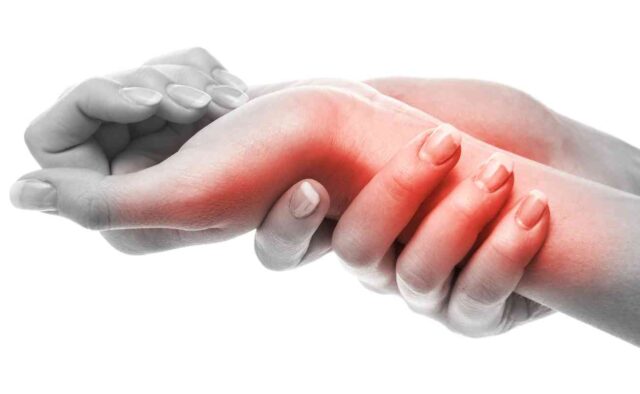
TFCC pain is usually felt on the little-finger side of the wrist, close to the end of the ulna. It may feel deep within the joint rather than directly under the skin and can become more noticeable when the wrist rotates or carries weight.
The painful area is often located:
- Just below the little finger
- Between the end of the ulna and the carpal bones
- Around the distal radioulnar joint
- Deep within the ulnar side of the wrist
However, several other conditions can cause pain in this region, including:
- Extensor carpi ulnaris tendon conditions
- Ulnar nerve irritation
- Wrist arthritis
- Ligament injuries
- Fractures
- Joint instability
Therefore, pain location alone does not confirm a TFCC injury. The Hand Society describes ulnar-sided wrist pain as a region with several possible sources that require assessment in context.
Why does the little-finger side of my wrist hurt?
Pain on the little-finger side of the wrist may involve the TFCC, but it may also arise from tendons, ligaments, bones, nerves or nearby joints. The injury history, exact movements that reproduce pain and clinical examination findings help identify the likely source.
TFCC-related discomfort may be more noticeable during:
- Forearm rotation
- Gripping
- Weight-bearing through the palm
- Swinging a racquet or golf club
- Lifting with one hand
- Using tools
- Pushing up from a chair
- Turning a key
- Carrying a heavy bag
Pain after a fall may require assessment for both soft-tissue injuries and fractures.

What causes a TFCC injury?
A TFCC injury may occur after a fall, forceful wrist rotation, sudden loading or repeated pressure through the hand. It may also develop gradually as the tissue changes over time. Sports involving gripping, rotation or weight-bearing through the wrist can increase TFCC loading.
Common causes include:
Falling onto an outstretched hand
A fall may compress and twist the wrist, affecting the TFCC and nearby ligaments.
Forceful rotation
Sudden forearm rotation, particularly while gripping an object, may strain TFCC structures.
Racquet and club sports
Tennis, badminton, squash and golf involve repeated gripping and rotational wrist forces.
Weight training
Push-ups, presses, heavy lifting and exercises that load the wrist in an extended position may aggravate symptoms.
Climbing and gymnastics
These activities may place substantial body weight through the hands. TFCC injuries are recognised among wrist injuries in climbers and other athletes who repeatedly load the wrist.
Repetitive manual work
Using tools, carrying heavy objects and repeated twisting movements may increase load through the ulnar side of the wrist.
Gradual tissue changes
TFCC tissue may undergo age-related or degenerative changes. These findings do not always cause symptoms, so examination and imaging should be interpreted together.
Who is more likely to develop a TFCC injury?
TFCC injuries can affect people of different ages. However, athletes, manual workers and people with previous wrist trauma may have greater exposure to gripping, twisting and weight-bearing forces that load the ulnar side of the wrist.
People commonly affected include:
- Tennis and badminton players
- Golfers
- Climbers
- Gymnasts
- Weightlifters
- Martial arts participants
- Racquet-sport players
- Manual workers
- Tradespeople
- People with previous wrist fractures
- Individuals who frequently bear weight through the hands
Certain anatomical differences, including the relative length of the ulna, may influence how force passes through the TFCC. However, anatomy alone does not determine whether pain will occur.
What activities may make TFCC pain worse?
Activities involving wrist rotation, forceful gripping, deviation towards the little-finger side or weight-bearing through the palm may increase TFCC symptoms. Activity modification usually involves adjusting the load, technique or duration rather than avoiding all hand use.
Common triggers include:
- Push-ups
- Planks
- Bench presses
- Heavy dumbbell exercises
- Racquet sports
- Golf
- Climbing
- Yoga positions that load the hands
- Using screwdrivers or hand tools
- Opening jars
- Carrying heavy bags
- Lifting a child
- Pushing up from a chair
- Repetitive forearm rotation
A wrist support or change in hand position may reduce aggravation for selected activities. However, repeated pain or instability should prompt assessment.
How is a TFCC injury diagnosed?
Diagnosis usually begins with a discussion about how the symptoms started, followed by examination of wrist movement, tenderness, grip, stability and forearm rotation. No single test confirms every TFCC injury, so clinicians consider the overall pattern of findings.
A clinical assessment may include:
- Medical and injury history
- Pain-location mapping
- Wrist range of motion
- Forearm rotation
- Grip-strength testing
- Tenderness around the TFCC
- Distal radioulnar joint stability
- Functional hand testing
- Review of sport and work demands
- Assessment of nearby tendons and nerves
- Review of previous imaging
A clinician may also examine the elbow and forearm when symptoms extend beyond the wrist.
Do I need an X-ray, MRI or ultrasound?
Not everyone with a suspected TFCC injury requires imaging. The choice depends on whether the injury followed trauma, whether a fracture is suspected and whether imaging is likely to influence diagnosis or management. MRI may help assess TFCC tissue, while X-rays assess bone and alignment.
X-ray
X-rays may help identify:
- Fractures
- Bone alignment
- Arthritis
- Relative ulnar length
- Previous traumatic changes
X-rays do not show the TFCC itself clearly.
MRI
MRI may provide information about:
- TFCC tears
- Ligaments
- Cartilage
- Bone injury
- Surrounding tendons and soft tissues
The American College of Radiology identifies MRI as an appropriate investigation in several chronic wrist-pain scenarios, while MR arthrography may provide additional detail for selected TFCC lesions. Imaging choice should follow the clinical question.
Musculoskeletal ultrasound
Ultrasound can assess selected wrist tendons, fluid collections and superficial structures. However, it may not show the entire TFCC as clearly as MRI. It can also support dynamic examination and guide selected procedures where appropriate.
Wrist arthroscopy
Wrist arthroscopy allows direct visualisation inside the joint and may sometimes be used to assess or treat TFCC injuries. It is an invasive surgical procedure rather than a routine first-line diagnostic test.
What treatment options are available for TFCC injuries?
Management depends on whether the injury is traumatic or gradual, whether the wrist is stable and how much symptoms affect daily function. Many people begin with activity modification, support and rehabilitation, while selected unstable or persistent injuries may require surgical review.
Possible management options include:
- Education about the injury
- Temporary reduction in painful wrist loading
- Modification of gripping and rotation
- Wrist support or splinting
- Medication following medical advice
- Gentle movement exercises
- Progressive forearm strengthening
- Grip rehabilitation
- Functional retraining
- Gradual return to sport
- Clinical review
- Image-guided platelet-rich plasma (PRP) injection in selected cases
- Surgical referral where clinically indicated
The treatment plan should consider the exact TFCC structure involved and whether the distal radioulnar joint remains stable.
Should I wear a wrist splint for a TFCC injury?
A wrist splint or brace may reduce painful rotation and loading during the early management of selected TFCC injuries. However, the type and duration should reflect the injury and clinical findings because unnecessary prolonged immobilisation may contribute to stiffness and weakness.
A support may be used:
- After an acute injury
- During painful work activities
- During selected sporting tasks
- To reduce repeated rotation
- As part of a structured rehabilitation plan
The support should not replace gradual restoration of movement and strength when these activities become appropriate.
Can a PRP injection help a TFCC injury?
Yes. For selected TFCC injuries, an ultrasound-guided platelet-rich plasma (PRP) injection can be a valuable non-surgical option. It uses your own concentrated growth factors to support healing of the injured tissue, and it works especially well for peripheral tears, which have their own blood supply, and where a nearby tendon such as the extensor carpi ulnaris (ECU) is involved at the same time.
PRP is prepared from a small sample of your own blood and placed precisely into the injured area under ultrasound guidance. Ulnar-sided wrist pain is often driven by more than one structure, and the extensor carpi ulnaris (ECU) tendon, which sits right next to the TFCC, is frequently involved as well. Treating both together, when appropriate, can settle pain and support a return to gripping, rotation and sport — and in practice this combined, image-guided approach works well for many people.
Depending on the individual’s condition and clinical assessment, certain procedures may be considered as part of a broader management plan.
Where appropriate, a procedure may complement:
- Activity modification
- Splinting
- Rehabilitation
- Strengthening
- Functional retraining
- Ongoing clinical review
An injection should not replace assessment of wrist stability or other causes of ulnar-sided pain.
What exercises may help a TFCC injury?
Exercises may help restore movement, forearm strength, grip and wrist control after symptoms begin to settle. However, there is no single programme for every TFCC injury, and exercises that repeatedly increase deep wrist pain or instability may need adjustment.
A rehabilitation programme may include:
- Gentle wrist flexion and extension
- Comfortable forearm rotation
- Isometric wrist-strength exercises
- Progressive grip training
- Forearm muscle strengthening
- Wrist-stability exercises
- Gradual weight-bearing through the hand
- Sport-specific grip and rotation practice
Rehabilitation should progress from low-load activities towards the individual’s work or sporting demands.
Can a TFCC injury improve without surgery?
Some TFCC injuries may improve with non-surgical management, particularly when the wrist remains stable and symptoms respond to load modification and rehabilitation. Surgery may be considered when instability, persistent mechanical symptoms or functional limitations remain despite suitable non-surgical care.
Factors that may influence progress include:
- Location and type of injury
- Wrist stability
- Symptom duration
- Previous trauma
- Work and sporting demands
- Ability to modify loading
- Response to splinting
- Rehabilitation progress
- Associated fractures or ligament injuries
Persistent pain does not automatically mean surgery is required.
When is surgery considered for a TFCC injury?
Surgery is not needed for most TFCC injuries. It may be considered for a minority — for example where the wrist is unstable, or where significant pain and loss of function continue despite non-surgical management and an appropriate trial of image-guided treatment.
Wrist arthroscopy may allow the surgeon to examine TFCC structures directly and perform treatment through small incisions. However, surgery involves risks, recovery and rehabilitation and should not be presented as appropriate for every tear.
How long does a TFCC injury take to recover?
Recovery varies according to the injury type, wrist stability, symptom duration and management plan. Mild or stable injuries may improve over several weeks or months, while more significant injuries or surgery may require a longer rehabilitation period.
Recovery may also depend on:
- The amount of weight placed through the wrist
- Grip and rotation demands
- Work duties
- Sporting goals
- Previous wrist injuries
- Immobilisation period
- Strength and movement recovery
- Associated tendon or ligament conditions
Return to sport should be based on wrist function and tolerance rather than time alone.
When should I seek medical assessment?
Seek assessment when little-finger-side wrist pain persists, repeatedly returns or affects gripping, rotation, work or sport. Prompt review may be needed after a fall, when swelling is marked or when the wrist feels unstable, locks or cannot support weight.
Consider assessment if:
- Pain continues for several weeks
- Grip strength decreases
- Wrist rotation becomes painful
- Clicking becomes painful
- The wrist repeatedly gives way
- Swelling persists
- Symptoms follow a fall
- Weight-bearing through the hand becomes difficult
- Self-management has not helped
Urgent medical attention may be appropriate if the wrist appears deformed, becomes cold or numb, or cannot move after significant trauma.
Assessment at Triaxis Sports & Joint Clinic
Triaxis Sports & Joint Clinic provides assessment for TFCC injuries, hand and wrist pain, sports-related wrist conditions and other upper-limb musculoskeletal concerns.
Clinical assessment focuses on symptom location, injury history, wrist movement, forearm rotation, grip, stability and activity demands. Depending on the findings, assessment may include musculoskeletal examination, functional hand testing, sports ultrasound where appropriate and review of previous imaging.
Patient education and shared decision-making form an important part of the consultation. Therefore, individuals can better understand the likely source of their symptoms, whether further investigation may help and which management options may be appropriate following clinical evaluation.
Frequently Asked Questions About TFCC Injuries
Is a TFCC injury the same as a wrist sprain?
Not exactly. A wrist sprain can involve several different ligaments, while a TFCC injury specifically affects structures on the little-finger side of the wrist. A TFCC tear may occur as part of a broader wrist sprain.
Can a TFCC tear cause clicking?
Yes. Some TFCC injuries cause clicking or catching during forearm rotation or wrist movement. However, clicking can also arise from tendons or other wrist structures and is not diagnostic by itself.
Can I lift weights with a TFCC injury?
Some people can continue modified strength training. Exercises involving heavy gripping, wrist rotation or weight-bearing through an extended wrist may need adjustment until strength and tolerance improve.
Should I avoid using my wrist completely?
Complete rest is not always necessary. Temporary reduction of painful loading may help, followed by gradual restoration of movement and strength where appropriate.
Can TFCC pain spread into the forearm?
Pain may extend slightly into the ulnar side of the forearm. Wider pain, numbness or tingling may suggest that a tendon, nerve or another structure also requires assessment.
Does every TFCC tear need surgery?
No. Stable injuries may begin with non-surgical management. Surgery may be considered for selected persistent or unstable tears based on symptoms, examination and imaging.
Can a PRP injection help a TFCC injury?
For selected injuries, yes. An ultrasound-guided PRP injection can support healing of peripheral TFCC tears and settle any associated extensor carpi ulnaris (ECU) tendon problem, and it is often used as part of non-surgical management. It is most suitable when the wrist is stable.
Can a TFCC injury happen without a fall?
Yes. Repeated gripping, rotation or weight-bearing can contribute to gradual TFCC symptoms, particularly in sport or manual work.
Can a TFCC injury return after treatment?
Symptoms may recur if wrist loading increases faster than the tissue can tolerate or if instability remains. Further assessment can determine whether symptoms relate to the TFCC or another wrist condition.
About the Author
Dr Dinesh Sirisena is a Consultant in Sports, Exercise and Musculoskeletal Medicine. His clinical work includes the assessment and non-surgical management of sports injuries, joint conditions and musculoskeletal pain.
Medical Disclaimer
This page provides general educational information and does not replace an individual medical consultation. Ulnar-sided wrist pain can have different causes, and suitable investigations or management options depend on each person’s symptoms, injury history and clinical assessment.