De Quervain’s Tenosynovitis

De Quervain’s Tenosynovitis: Causes, Symptoms and Treatment Options

Written and medically reviewed by Dr Dinesh Sirisena
Consultant in Sports, Exercise & Musculoskeletal Medicine
Triaxis Sports & Joint Clinic

De Quervain’s Tenosynovitis is a condition that causes pain on the thumb side of the wrist. It affects two tendons that help move the thumb as they pass through a narrow tendon sheath. Symptoms often increase during gripping, lifting, twisting or repeated thumb movement. Many people begin with activity modification, splinting and rehabilitation. Injections or surgery may be considered in selected cases following clinical assessment.

De Quervain's Tenosynovitis Ultrasound

Key Points at a Glance

  • De Quervain’s Tenosynovitis affects tendons on the thumb side of the wrist.
  • Pain commonly increases during gripping, lifting and thumb movement.
  • Swelling or tenderness may develop near the base of the thumb.
  • Repeated hand use may aggravate symptoms, although there is not always one clear cause.
  • Pregnancy and caring for a young child may coincide with the condition in some people.
  • Diagnosis usually relies on symptom history and physical examination.
  • Not everyone requires an X-ray, MRI or ultrasound scan.
  • Many people begin with non-surgical management before considering surgery.

What is De Quervain’s Tenosynovitis?

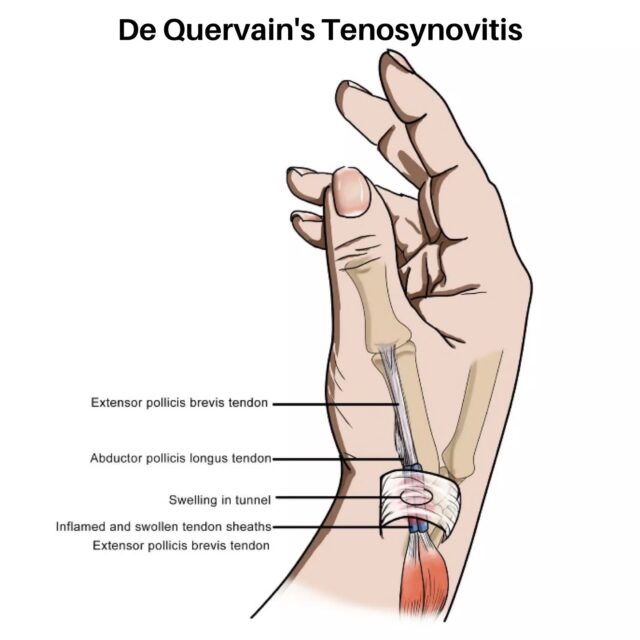
De Quervain’s Tenosynovitis is a painful condition involving two thumb tendons as they pass through a tunnel on the thumb side of the wrist. Thickening or irritation around the tendon sheath can restrict smooth tendon movement and cause pain during thumb and wrist activities.

The two tendons involved are called:

  • Abductor pollicis longus
  • Extensor pollicis brevis

These tendons help move the thumb away from the hand and straighten it. They pass through the first dorsal extensor compartment, a narrow tunnel near the wrist.

A slippery layer normally helps the tendons move smoothly. However, when the sheath becomes thickened or irritated, the tendons may not glide as freely. As a result, thumb movement, gripping and wrist deviation may become uncomfortable.

Despite the name, the condition does not involve an infection. It is a mechanical tendon-sheath condition rather than infectious tenosynovitis.

What does De Quervain’s Tenosynovitis feel like?

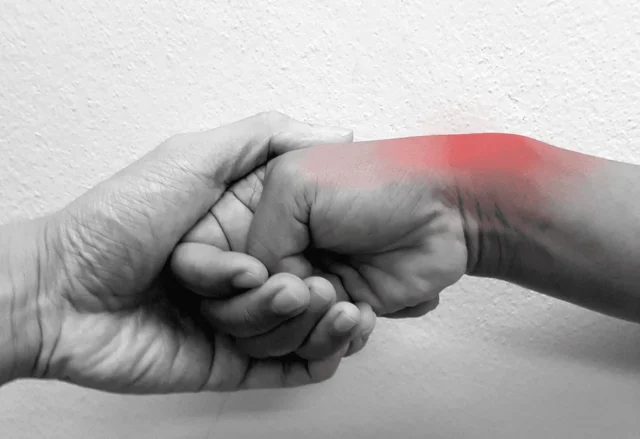
De Quervain’s Tenosynovitis commonly causes pain and tenderness near the base of the thumb on the outer side of the wrist. The pain may feel aching or sharp and often becomes more noticeable during gripping, lifting, twisting or moving the thumb.

Common symptoms include:

  • Pain on the thumb side of the wrist
  • Tenderness near the base of the thumb
  • Swelling around the painful area
  • Pain while gripping
  • Discomfort when lifting objects
  • Pain while opening jars
  • Difficulty turning keys
  • Pain during phone use
  • Symptoms when carrying a child
  • Reduced thumb movement
  • A catching or creaking sensation in some cases
  • Reduced grip or pinch strength

Symptoms may develop gradually. However, some people first notice them after a sudden increase in repetitive hand use.

Where is De Quervain’s pain usually felt?

Pain is usually felt along the thumb side of the wrist, close to the end of the radius bone. It may spread into the thumb or slightly up the forearm, particularly during repeated movement or forceful gripping.

The painful area usually sits over the first extensor compartment, near the bony prominence on the thumb side of the wrist.

Symptoms may be felt during:

  • Moving the thumb away from the palm
  • Bending the wrist towards the little-finger side
  • Gripping an object firmly
  • Lifting with the thumb pointing upwards
  • Twisting the wrist
  • Pinching between the thumb and fingers

Pain further into the hand, widespread finger numbness or symptoms extending from the neck may suggest that another condition also needs consideration.

Why does the thumb side of my wrist hurt?

Pain on the thumb side of the wrist may arise from De Quervain’s Tenosynovitis, but other causes include thumb-joint conditions, tendon injuries, wrist sprains and fractures. The pain pattern, injury history and physical examination help distinguish between these possibilities.

Possible alternative causes include:

  • Thumb-base arthritis
  • Scaphoid injury
  • Wrist ligament sprain
  • Intersection syndrome
  • Superficial radial nerve irritation
  • Ganglion cyst
  • Other tendon-related conditions

Therefore, thumb-side wrist pain should not automatically be labelled as De Quervain’s without an assessment, especially after a fall or direct injury.

What causes De Quervain’s Tenosynovitis?

The condition develops when the tendons and their surrounding sheath become thickened or irritated, making tendon movement more painful. Repeated gripping, lifting and thumb motion may contribute, although many people cannot identify one single activity that caused the symptoms.

Possible contributing factors include:

  • Repeated lifting
  • Forceful gripping
  • Repetitive thumb movement
  • Sudden increases in hand activity
  • Racquet sports
  • Golf
  • Weight training
  • Manual work
  • Gardening
  • Frequent use of tools
  • Caring for a young child
  • Previous wrist injury

The term “overuse” can be helpful, but it may oversimplify the condition. People often develop symptoms because the total load placed on the tendons exceeds their current capacity rather than because one activity is inherently harmful.


De-Quervains-Tenosynovitis Anatomy

Is De Quervain’s caused by phone use?

Phone use may aggravate De Quervain’s symptoms when it involves repeated thumb movements or prolonged gripping. However, using a phone does not explain every case, and the condition usually reflects a combination of tendon loading, hand position and individual factors.

Activities such as scrolling, typing with one thumb and holding a large phone may increase thumb-tendon activity.

Possible modifications include:

  • Using both hands
  • Switching between fingers
  • Reducing prolonged one-handed use
  • Using voice input
  • Taking movement breaks
  • Supporting the phone rather than gripping it tightly

These changes may reduce aggravation, but persistent pain may still require clinical assessment.

Can pregnancy or lifting a baby cause De Quervain’s?

De Quervain’s may occur during pregnancy or after childbirth. Hormonal and fluid changes may contribute, while repeated lifting and holding of a baby can also increase demand on the thumb and wrist tendons. However, the condition does not affect every new parent.

Commonly aggravating movements include lifting a baby under the arms with the thumbs spread widely, carrying the child with the wrist bent and repeatedly supporting the baby’s head.

Helpful adjustments may include:

  • Keeping the wrist in a more neutral position
  • Lifting with the palms and forearms
  • Keeping the thumbs closer to the hand
  • Alternating carrying positions
  • Using pillows for feeding support
  • Asking for help with repeated lifting where possible

Any medication or injection decisions during pregnancy or breastfeeding should be discussed with an appropriate medical professional.

Who is more likely to develop De Quervain’s Tenosynovitis?

De Quervain’s can affect people of different ages, although it is more frequently reported in women and during pregnancy or the period after childbirth. Repetitive gripping, manual work, racquet sports and previous wrist conditions may also increase tendon loading.

People who may experience symptoms include:

  • Parents and caregivers of young children
  • Office workers
  • Healthcare workers
  • Chefs
  • Musicians
  • Hairdressers
  • Tradespeople
  • Gardeners
  • Tennis and badminton players
  • Golfers
  • Weightlifters
  • People who frequently use hand tools

Having one or more of these factors does not mean that the condition will develop.

What activities may make De Quervain’s worse?

Activities that involve repeated thumb movement, forceful gripping, twisting or lifting with the wrist angled towards the little-finger side may increase symptoms. However, the aggravating activity differs between individuals and does not always need to stop completely.

Common triggers include:

  • Lifting a baby
  • Carrying shopping bags
  • Opening jars
  • Turning keys
  • Using scissors
  • Gardening
  • Racquet sports
  • Golf
  • Weightlifting
  • Using tools
  • Prolonged phone use
  • Gaming
  • Repetitive food preparation
  • Push-ups or exercises that load the wrist

Activity modification may involve reducing force, changing grip, using both hands or temporarily lowering repetition.

Complete rest may reduce short-term irritation but can also lead to stiffness or reduced strength if continued for too long.

How is De Quervain’s Tenosynovitis diagnosed?

Diagnosis usually begins with a discussion about pain location and aggravating activities, followed by an examination of the thumb, wrist and tendons. Clinicians may use movement-based tests to reproduce symptoms, while also assessing for other causes of thumb-side wrist pain.

A clinical assessment may include:

  • Medical and activity history
  • Pain-location mapping
  • Thumb and wrist movement
  • Tendon tenderness
  • Grip and pinch assessment
  • Swelling examination
  • Functional hand testing
  • Nerve assessment where appropriate
  • Review of any previous wrist injury

Tests that place the thumb tendons under tension may support the assessment. However, a painful test alone should not be interpreted without considering the full clinical picture.

Do I need an X-ray, MRI or ultrasound scan?

Most people with a typical presentation do not require imaging to diagnose De Quervain’s Tenosynovitis. A scan may be considered when the diagnosis is unclear, symptoms followed trauma or another tendon, joint, bone or nerve condition is suspected.

X-ray

An X-ray does not show the tendon sheath in detail. However, it may help assess fractures, thumb-joint arthritis or other bone-related causes of pain.

Musculoskeletal ultrasound

Ultrasound can show the thumb tendons, tendon sheath and anatomical variations within the first extensor compartment. It may also support dynamic examination and guide selected injections.

MRI

MRI is not routinely required. It may be considered when deeper soft-tissue assessment is needed or when the clinical findings do not clearly identify the cause.

The choice of imaging should follow the clinical question rather than serve as routine screening.

What treatment options are available for De Quervain’s?

Management aims to reduce aggravating tendon load while maintaining useful hand and wrist function. Many people begin with education, activity modification, a thumb-and-wrist splint and rehabilitation. Medication, injection or surgery may be discussed depending on symptoms and clinical findings.

Possible management options include:

  • Education about the condition
  • Modification of painful activities
  • Changes to lifting and gripping technique
  • A thumb-spica splint where appropriate
  • Thumb and wrist mobility exercises
  • Gradual strengthening
  • Workplace or equipment adjustments
  • Medication following medical advice
  • Corticosteroid injection in selected cases
  • Platelet-rich plasma (PRP) injection in selected cases, such as a tendon tear or chronic symptoms
  • Surgical review when clinically indicated

The most appropriate combination depends on symptom duration, daily demands, medical history and previous management.

Should I wear a thumb or wrist splint?

A thumb-spica splint may reduce movement and loading of the affected tendons during painful activities. However, splint choice and duration should reflect the individual’s symptoms and daily tasks, because unnecessary prolonged immobilisation may contribute to stiffness or weakness.

A suitable splint generally supports both the wrist and thumb while allowing the fingers to move.

It may be used:

  • During aggravating activities
  • For a defined period during a painful phase
  • Alongside activity modification
  • After an injection where clinically advised

The aim is to reduce irritation without making the hand completely inactive for longer than needed.

Can a corticosteroid injection help De Quervain’s?

A corticosteroid injection into the tendon sheath may be considered when symptoms remain limiting despite initial management or when clinical findings support this option. Some evidence supports injections for symptom and function improvement, although individual responses vary and possible risks should be discussed beforehand.

Ultrasound guidance may help identify anatomical variations and place medication within the intended tendon compartment.

Possible risks can include:

  • Temporary pain after the procedure
  • Skin colour change
  • Local fat or skin thinning
  • Infection
  • Bleeding or bruising
  • Tendon injury, although uncommon
  • Incomplete or temporary symptom improvement

Depending on the individual’s condition and clinical assessment, an injection may be considered as part of a broader management plan rather than as a guaranteed solution.

Can platelet-rich plasma (PRP) help De Quervain’s?

While a corticosteroid injection is generally aimed at settling pain and inflammation, a platelet-rich plasma (PRP) injection may be considered in a different situation — particularly where imaging shows a tendon tear, or where symptoms have become chronic and have not responded to earlier measures.

PRP is prepared from a small sample of the person’s own blood, concentrating the platelets that carry natural growth factors. When placed around the affected tendons under ultrasound guidance, it aims to support the tendon’s healing response rather than simply reduce inflammation. For this reason it is more often considered where the underlying problem is a degenerative or torn tendon rather than short-term irritation.

The choice between a corticosteroid injection, PRP or other options depends on symptom duration, whether a tear is present, previous treatments and individual circumstances. As with any injection, the potential benefits and limitations should be discussed beforehand, and it is generally used as part of a broader management plan rather than as a standalone solution.

What exercises may help De Quervain’s?

Exercises may help maintain thumb and wrist movement and gradually improve tendon tolerance. However, exercise selection and timing should match the level of irritation, because forceful stretching or strengthening during a painful phase may increase symptoms.

A rehabilitation programme may include:

  • Gentle thumb movement
  • Comfortable wrist mobility
  • Tendon-gliding exercises
  • Gradual thumb-abduction strengthening
  • Wrist-strengthening exercises
  • Grip and pinch progression
  • Functional lifting practice
  • Gradual return to sport or work tasks

Exercises should remain controlled. Mild effort may be acceptable, but repeated sharp pain or increasing swelling may mean the load requires adjustment.

Can De Quervain’s improve without surgery?

Many people begin with non-surgical management and may improve through activity modification, splinting, rehabilitation or injection where appropriate. Surgery is generally considered only when symptoms remain functionally limiting despite a suitable period of non-surgical care.

Surgical treatment involves releasing the tight tendon compartment to create more space for the tendons.

Surgery may be discussed when:

  • Symptoms remain persistent
  • Daily hand use remains limited
  • Non-surgical options have not provided sufficient improvement
  • Clinical findings continue to support the diagnosis

Persistent pain does not automatically mean surgery is required.

How long does De Quervain’s usually last?

The duration varies according to symptom severity, daily tendon load, medical factors and response to management. Some people improve over several weeks, while longer-standing symptoms may require several months of activity adjustment, rehabilitation and clinical review.

Factors that may influence progress include:

  • How long symptoms were present before assessment
  • Work and caregiving demands
  • Ability to modify repetitive tasks
  • Use of a splint where suitable
  • Response to rehabilitation
  • Associated thumb or wrist conditions
  • Pregnancy or postnatal factors

Improvement in grip, lifting tolerance and daily function can be as relevant as changes in pain.

When should I seek medical assessment?

Seek assessment when thumb-side wrist pain persists, repeatedly returns or affects lifting, work, caregiving, sport or sleep. Prompt review may be appropriate after a fall, when swelling becomes marked or when weakness, numbness or loss of movement develops.

Consider assessment if:

  • Pain lasts several weeks
  • Lifting becomes difficult
  • Grip or pinch strength decreases
  • Swelling persists
  • Symptoms regularly disturb sleep
  • Pain follows an injury
  • Thumb movement becomes restricted
  • Numbness or tingling develops
  • Self-management has not helped

Urgent assessment may be needed after trauma if the wrist appears deformed, becomes cold or numb, or cannot move or hold objects.

Assessment at Triaxis Sports & Joint Clinic

Triaxis Sports & Joint Clinic provides assessment for De Quervain’s Tenosynovitis, hand and wrist pain, tendon conditions and other upper-limb musculoskeletal concerns.

Clinical assessment focuses on understanding pain location, thumb and wrist movement, grip, activity demands, medical history and factors that may aggravate symptoms. Depending on the findings, assessment may include musculoskeletal examination, functional hand testing, sports ultrasound where appropriate and review of previous imaging.

Patient education and shared decision-making form an important part of the consultation. Therefore, individuals can better understand the possible source of their symptoms, whether further investigations may help and which management options may be appropriate following clinical evaluation.

Frequently Asked Questions About De Quervain’s Tenosynovitis

Is De Quervain’s the same as carpal tunnel syndrome?

No. De Quervain’s affects two tendons on the thumb side of the wrist and usually causes localised pain during thumb or wrist movement. Carpal tunnel syndrome affects the median nerve and more commonly causes numbness or tingling in the thumb, index and middle fingers.

Can De Quervain’s cause numbness?

Numbness is not a typical main symptom. Pain and tenderness are more common. Persistent tingling or numbness may suggest irritation of a nearby nerve or another condition that requires assessment.

Should I massage De Quervain’s?

Gentle massage may ease surrounding muscle tension for some people, but firm pressure over an irritated tendon sheath may increase pain. Massage should not replace load modification, rehabilitation or assessment where symptoms persist.

Can I continue exercising with De Quervain’s?

Many people can remain active after changing exercises that involve painful gripping, thumb loading or wrist weight-bearing. The programme should maintain general activity while reducing repeated aggravation of the affected tendons.

Can De Quervain’s affect both wrists?

Yes, although one wrist may be more painful. Bilateral symptoms may occur when similar activities load both hands or during pregnancy and the postnatal period.

Does De Quervain’s go away after pregnancy?

Symptoms may improve as postnatal hormonal and activity demands change. However, persistent pain may still require assessment, activity modification, rehabilitation or other management options.

Is the Finkelstein test enough to diagnose De Quervain’s?

No single test should confirm the diagnosis by itself. The pain pattern, physical examination, activity history and assessment of alternative causes should all be considered.

When is surgery considered?

Surgery may be considered when symptoms remain limiting despite suitable non-surgical management and the diagnosis remains clinically supported. It is not usually the first management option.

About the Author

Dr Dinesh Sirisena is a Consultant in Sports, Exercise and Musculoskeletal Medicine. His clinical work includes the assessment and non-surgical management of sports injuries, joint conditions and musculoskeletal pain.

Medical Disclaimer

This page provides general educational information and does not replace an individual medical consultation. Thumb and wrist symptoms can have different causes, and suitable investigations or management options depend on each person’s symptoms, medical history and clinical assessment.

Leave a Reply

Your email address will not be published. Required fields are marked *