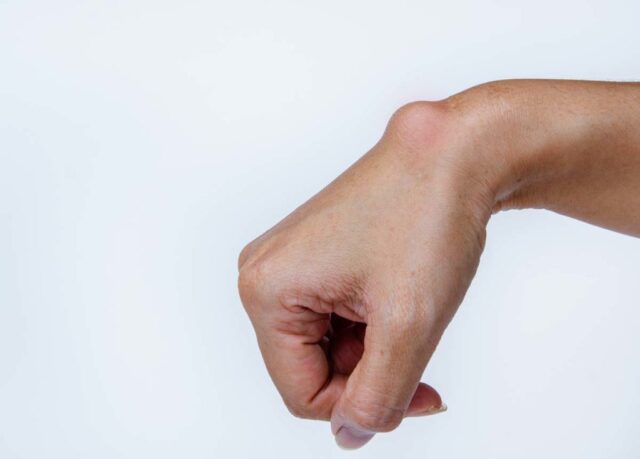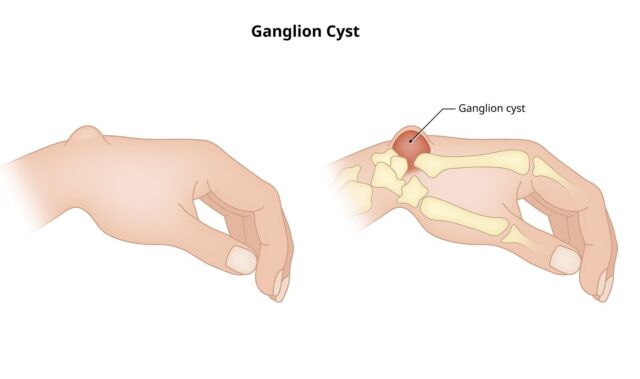
Ganglions

Ganglion Cysts: Causes, Symptoms and Treatment Options

Written and medically reviewed by Dr Dinesh Sirisena
Consultant in Sports, Exercise & Musculoskeletal Medicine
Triaxis Sports & Joint Clinic

Ganglion cysts are non-cancerous, fluid-filled lumps that usually develop near a joint or tendon, most commonly around the wrist or hand. Many do not cause symptoms and may reduce in size or disappear without treatment. Assessment may be appropriate when a lump becomes painful, restricts movement, affects grip or causes nerve-related symptoms. Management may include observation, aspiration or surgery in selected cases.

Ganglion Right Hand Cyst

Key Points at a Glance

  • Ganglion cysts commonly appear around the wrist, hand, fingers, foot or ankle.
  • They contain thick, jelly-like fluid and develop near joints or tendon sheaths.
  • The lump may change in size and can sometimes become smaller without treatment.
  • Many ganglion cysts do not cause pain or affect function.
  • Some may cause discomfort, weakness, restricted movement, tingling or numbness.
  • Diagnosis often begins with clinical examination.
  • Ultrasound or MRI may be considered when the diagnosis is uncertain.
  • Aspiration and surgery may be discussed when symptoms affect daily function, although recurrence can occur.

What is a ganglion cyst?

A ganglion cyst is a fluid-filled lump that develops near a joint capsule or tendon sheath. It most commonly appears around the wrist or hand, although it can also occur near the fingers, foot or ankle. Ganglion cysts are generally non-cancerous and may be painless.

Joints contain lubricating fluid that supports movement, while tendon sheaths help tendons glide. A ganglion cyst forms when thick fluid collects within a small sac connected to or arising near one of these structures.

Ganglion cysts vary in size. Some remain small, while others become more noticeable after activity. A cyst may feel soft and mobile, although some feel firm because of the pressure inside.

The term ganglion cyst should not be confused with a neurological ganglion, which refers to a group of nerve-cell bodies.

What does a ganglion cyst feel like?

A ganglion cyst usually feels like a smooth, rounded or oval lump beneath the skin. It may feel soft, rubbery or firm. Many are painless, although some cause aching, tenderness or discomfort when the nearby joint or tendon moves.

Possible symptoms include:

  • A visible or noticeable lump
  • Aching around the wrist or hand
  • Tenderness with pressure
  • Discomfort during gripping
  • Pain during wrist movement
  • Reduced range of motion
  • Weakness or reduced grip
  • Tingling or numbness if the cyst presses on a nerve
  • Difficulty placing weight through the wrist
  • Symptoms during sport or manual work

Some people notice the lump before experiencing any discomfort. Others become aware of it only when it affects an activity such as typing, lifting, push-ups or racquet sports.

Where do ganglion cysts usually appear?

Ganglion cysts most commonly develop on the back or palm side of the wrist. They may also appear near the base of a finger, around a finger joint, on the foot or near the ankle. The location may influence which movements become uncomfortable.

Common locations include:

Back of the wrist

This is a frequent location. The lump may become more visible when the wrist bends forward and may cause discomfort during push-ups, planks or lifting.

Palm side of the wrist

A cyst may appear near the base of the thumb. Because important arteries and nerves pass through this area, assessment and any procedure require attention to the surrounding anatomy.

Base of a finger

A small cyst may develop near a flexor tendon sheath and cause discomfort during gripping.

End joint of a finger

A cyst near the final finger joint may occur alongside joint changes and may affect the nail in some cases.

Foot or ankle

Ganglion cysts can also develop near foot and ankle joints or tendons, where footwear or walking may increase pressure on the lump.

Why has a lump appeared on my wrist?

A wrist lump may be a ganglion cyst, but other causes include tendon swelling, a bony prominence, arthritis-related changes or another soft-tissue mass. Clinical assessment helps distinguish between these possibilities, especially if the lump is new, enlarging, painful or unusually firm.

Ganglion cysts are among the most common lumps found in the hand and wrist. However, appearance alone cannot always confirm the diagnosis.

Features that may support a ganglion cyst include:

  • A smooth, rounded shape
  • A location close to a joint or tendon
  • A size that changes over time
  • Increased prominence after activity
  • Mild aching rather than severe constant pain
  • A lump that moves slightly under the skin

A lump that grows quickly, causes skin changes, feels fixed or produces progressive neurological symptoms should be assessed.

Ganglions Anatomy

What causes ganglion cysts?

The precise cause of ganglion cysts is not always known. They appear to arise from tissues around a joint or tendon sheath, and repeated joint or tendon loading may contribute in some people. However, many develop without a clear injury or identifiable trigger.

Possible contributing factors include:

  • Repetitive wrist movement
  • Previous joint or tendon irritation
  • Gym or weight-bearing activities
  • Racquet sports
  • Golf
  • Manual work
  • Joint changes
  • Previous wrist injury
  • Repeated pressure through the hand

Nevertheless, having these factors does not mean that a cyst will develop. Ganglion cysts may also occur in people without heavy physical activity.

Why does a ganglion cyst change in size?

A ganglion cyst may change in size because it is connected to a joint capsule or tendon sheath. Activity can increase movement or pressure around that structure, making the cyst more noticeable. It may become smaller during periods of reduced activity and can sometimes temporarily disappear.

A changing size is common and does not necessarily indicate that the condition is becoming more serious.

However, a cyst that repeatedly enlarges may create:

  • Greater pressure under the skin
  • Discomfort during movement
  • Difficulty wearing a watch or equipment
  • Reduced grip
  • Nerve-related symptoms
  • Cosmetic concern

The size of the lump does not always match the level of pain. A small cyst near a sensitive structure may cause more symptoms than a larger painless one.

Are ganglion cysts cancerous?

Ganglion cysts are generally benign and are not cancer. However, not every lump around the wrist or hand is a ganglion cyst, so assessment may be appropriate when the diagnosis is uncertain or the lump has unusual features.

Seek assessment if a lump:

  • Grows quickly
  • Feels hard and fixed
  • Causes persistent night pain
  • Produces skin changes
  • Is associated with unexplained illness
  • Develops after significant trauma
  • Causes progressive numbness or weakness
  • Does not resemble a typical ganglion cyst

A clinician may recommend further imaging or referral if the appearance or examination findings are not typical.

Who is more likely to develop a ganglion cyst?

Ganglion cysts can affect people of different ages, although they are frequently seen in younger and middle-aged adults. They may occur in active people, manual workers and individuals who repeatedly load the wrist, but many appear without a clear occupational or sporting cause.

Activities that may make an existing cyst more noticeable include:

  • Weightlifting
  • Push-ups
  • Yoga positions that load the wrist
  • Tennis or badminton
  • Golf
  • Climbing
  • Gymnastics
  • Repetitive manual work
  • Prolonged tool use
  • Frequent lifting

These activities do not necessarily need to stop permanently. Modification may be enough when symptoms are mild.

How is a ganglion cyst diagnosed?

A ganglion cyst can often be identified through medical history and physical examination. The clinician assesses the lump’s location, size, consistency, mobility and effect on movement, grip and sensation. Imaging may be considered when the diagnosis is uncertain or another condition is suspected.

Assessment may include:

  • When the lump first appeared
  • Whether its size changes
  • Pain or tenderness
  • Wrist and finger movement
  • Grip strength
  • Nerve sensation
  • Previous injury
  • Work or sporting activities
  • Examination of nearby joints and tendons

A light may sometimes be used to assess whether the lump allows light to pass through, although this finding alone does not confirm the diagnosis.

Do I need an X-ray, ultrasound or MRI?

Not everyone with a suspected ganglion cyst requires imaging. Ultrasound may help confirm that a lump contains fluid and assess nearby tendons, nerves or blood vessels. MRI may be considered when the lump is deep or the diagnosis remains uncertain. X-rays do not show the cyst directly but may identify bone or joint changes.

Possible investigations include:

Musculoskeletal ultrasound

Ultrasound can:

  • Show whether the lump is fluid-filled
  • Assess its relationship to nearby structures
  • Identify some alternative diagnoses
  • Support image-guided aspiration where appropriate

MRI

MRI may provide more detail when:

  • The cyst is not clearly visible
  • Symptoms suggest a deeper lesion
  • Another soft-tissue condition is suspected
  • Surgical planning requires additional information

X-ray

An X-ray may help assess:

  • Arthritis
  • Previous fractures
  • Bone alignment
  • Other joint-related causes of a lump

The choice of imaging should follow the clinical assessment rather than serve as routine screening.

Can a ganglion cyst disappear on its own?

Yes. Some ganglion cysts reduce in size or disappear without treatment. Observation may be suitable when the lump is not painful, does not affect movement and has been clinically assessed as a typical ganglion cyst.

During observation, a person may monitor:

  • Changes in size
  • Development of pain
  • Reduced movement
  • Numbness or tingling
  • Grip weakness
  • Interference with work or sport

There is usually no need to treat a painless ganglion solely because it is present. However, cosmetic concerns can still be discussed during consultation.

What treatment options are available for ganglion cysts?

Management depends on whether the cyst causes pain, restricts movement, presses on a nerve or affects daily function. Options may include observation, temporary activity modification, aspiration or surgical removal in selected cases.

Observation

A painless cyst that does not affect function may be monitored without intervention.

Activity modification

Reducing activities that repeatedly compress or load the area may decrease discomfort. For a wrist cyst, this might involve modifying push-ups, heavy lifting or prolonged weight-bearing.

Support or splinting

A temporary wrist support may reduce aggravating movement in selected cases. Prolonged immobilisation is not always appropriate because it may contribute to stiffness or weakness.

Aspiration

A clinician may use a needle to withdraw fluid from the cyst. Aspiration can reduce the lump, although the cyst may return because the connection to the joint or tendon remains. In some cases a corticosteroid (steroid) injection may be given at the same time, which can help settle symptoms for some people, although it does not guarantee that the cyst will not come back.

Surgery

Surgical excision may be considered when symptoms continue, function remains limited or the cyst repeatedly returns after other management. Surgery also carries risks, and recurrence can still occur.

Can a ganglion cyst be drained?

A ganglion cyst can sometimes be aspirated using a needle. This may reduce the size of the lump and relieve pressure-related symptoms. However, recurrence is possible because aspiration removes the fluid but may not remove the cyst wall or its connection to the joint or tendon.

Aspiration may be less suitable when:

  • The cyst lies close to an artery or nerve
  • The diagnosis is uncertain
  • The cyst is very small or difficult to access
  • The lump is not fluid-filled
  • Infection is suspected
  • The person has certain bleeding risks

Depending on the location, ultrasound guidance may help identify nearby structures and guide needle placement.

A ganglion cyst should not be struck or deliberately burst at home. This may cause injury, bleeding, infection or damage to nearby structures.

Can injections help a ganglion cyst?

A ganglion cyst is usually managed through observation, aspiration or surgery rather than by injecting medication alone. In selected cases, aspiration may be combined with a corticosteroid (steroid) injection, which can help reduce symptoms for some people. Practice varies, and the cyst can still return afterwards.

The key consideration is not simply whether a substance can be injected, but whether the cyst:

  • Causes pain
  • Restricts movement
  • Presses on a nerve
  • Repeatedly returns
  • Affects work or sport
  • Has a clearly established diagnosis

Depending on the individual’s condition and clinical assessment, a procedure may be considered as part of a broader management plan.

Where this is appropriate, the fluid is first withdrawn from the cyst with a needle, and a small amount of corticosteroid may then be injected into the same area — often with ultrasound guidance to help avoid nearby nerves and blood vessels. This can ease pain and reduce the lump for some people, but it is not always successful and the cyst may return, in which case surgery may be discussed.

What activities may make a ganglion cyst more painful?

Activities that repeatedly bend, load or place pressure through the affected joint may increase discomfort or make the cyst more noticeable. The exact trigger depends on its location, so activity modification should focus on the relevant movement rather than require complete rest.

Common triggers may include:

  • Push-ups
  • Planks
  • Weightlifting
  • Yoga poses that load the wrist
  • Racquet sports
  • Golf
  • Climbing
  • Cycling
  • Heavy gripping
  • Manual tool use
  • Wearing tight wrist equipment

Modification may involve changing the hand position, reducing load, using equipment support or temporarily limiting the aggravating movement.

Do exercises help ganglion cysts?

Exercises do not remove the cyst itself. However, movement and strengthening may help maintain joint mobility, grip and function when pain has led to reduced use. Exercise should not repeatedly compress the cyst or significantly increase symptoms.

A rehabilitation plan may include:

  • Gentle wrist or finger movement
  • Grip exercises
  • Forearm strengthening
  • Gradual return to weight-bearing
  • Ergonomic changes
  • Sport-specific movement practice

Exercise may be particularly relevant after a period of splint use, aspiration or surgery. However, the programme should reflect the cyst location and clinical findings.

Can ganglion cysts return after treatment?

Yes. Ganglion cysts may return after aspiration and can occasionally recur after surgery. The likelihood varies according to the cyst’s location, anatomy and the treatment used. Recurrence does not necessarily mean that a procedure was performed incorrectly.

Follow-up assessment may consider:

  • Whether the lump is a recurrent ganglion
  • Whether symptoms have changed
  • Whether nerve or joint function is affected
  • Whether further observation is reasonable
  • Whether another procedure should be discussed

Treatment decisions should consider symptoms and function rather than appearance alone.

When should I seek medical assessment?

Seek assessment when a lump is painful, enlarging, uncertain in diagnosis or affecting movement, grip, sensation, work or sport. Prompt review may be appropriate when the lump appears after trauma or causes progressive numbness, weakness, skin changes or severe pain.

Consider assessment if:

  • The lump continues to grow
  • Pain persists or increases
  • Movement becomes restricted
  • Grip strength decreases
  • Tingling or numbness develops
  • The lump becomes red, hot or very tender
  • Symptoms affect work or exercise
  • The diagnosis is uncertain
  • The lump returns after a procedure

Urgent medical attention may be appropriate if the hand becomes cold, pale, severely swollen or loses movement or sensation.

Assessment at Triaxis Sports & Joint Clinic

Triaxis Sports & Joint Clinic provides assessment for ganglion cysts, hand and wrist pain, tendon conditions and other upper-limb musculoskeletal concerns.

Clinical assessment focuses on the lump’s location, size, symptoms, effect on movement and relationship to nearby joints, tendons and nerves. Depending on the findings, assessment may include musculoskeletal examination, functional hand testing, sports ultrasound where appropriate and review of previous imaging.

Patient education and shared decision-making form an important part of the consultation. Therefore, individuals can better understand whether observation, further investigation or a procedural option may be appropriate following clinical evaluation.

Frequently Asked Questions About Ganglion Cysts

Is a ganglion cyst hard or soft?

It may feel soft, rubbery or firm depending on its size, depth and the pressure of the fluid inside. A firm lump is not automatically concerning, although an uncertain or fixed lump should be assessed.

Can a ganglion cyst cause numbness?

Yes. A cyst may cause tingling, numbness or weakness if it places pressure on a nearby nerve. Persistent neurological symptoms require assessment.

Should I massage a ganglion cyst?

Massage does not remove the cyst and firm pressure may irritate the area. Gentle movement around the joint may be reasonable, but repeatedly pressing or attempting to burst the lump is not advised.

Can I exercise with a ganglion cyst?

Many people can remain active if the cyst is painless and function is unaffected. Exercises that place direct pressure on the lump may need temporary modification.

Does a ganglion cyst mean I have arthritis?

No. Ganglion cysts can occur without arthritis. However, some cysts near finger joints may develop alongside joint changes, so assessment depends on the location and symptoms.

Is aspiration painful?

Aspiration involves a needle and may cause temporary discomfort. Local anaesthetic may be used depending on the procedure and location. The possible risks and recurrence should be discussed beforehand.

Will a ganglion cyst grow back after surgery?

It can recur after surgery, although surgery generally removes more of the cyst and its connection than aspiration. The possible benefits and risks should be discussed during surgical review.

Can a ganglion cyst become infected?

A typical ganglion cyst is not an infection. However, redness, warmth, increasing tenderness, discharge or fever may indicate another problem that requires prompt medical assessment.

About the Author

Dr Dinesh Sirisena is a Consultant in Sports, Exercise and Musculoskeletal Medicine. His clinical work includes the assessment and non-surgical management of sports injuries, joint conditions and musculoskeletal pain.

Medical Disclaimer

This page provides general educational information and does not replace an individual medical consultation. Lumps around the hand, wrist, foot or ankle can have different causes, and suitable investigations or management options depend on each person’s symptoms, medical history and clinical assessment.

Leave a Reply

Your email address will not be published. Required fields are marked *