Sports Concussion: Symptoms, Recovery and Safe Return to Sport
Written and medically reviewed by
Dr Dinesh Sirisena
Consultant in Sports, Exercise & Musculoskeletal Medicine
Triaxis Sports & Joint Clinic
A sports concussion is a brain injury caused by a knock to the head, face, neck or body that temporarily changes how the brain works. It can cause headache, dizziness, feeling “foggy”, poor concentration, sleep disturbance and changes in mood, and it does not require a loss of consciousness. The encouraging news is that most athletes recover fully within about a month, and recovery is helped by early light activity, a structured return-to-sport plan and expert sports medicine guidance. At Triaxis, concussion care combines a detailed clinical assessment, an individualised exercise prescription and targeted rehabilitation for neck, balance and vision symptoms, so athletes can return to learning, work and sport safely and with confidence.
What is a sports concussion?
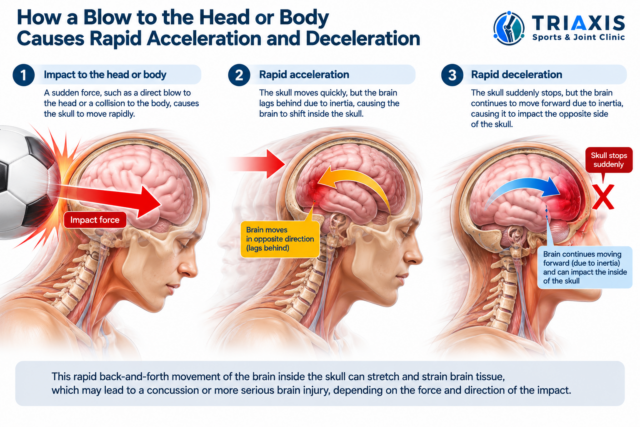
A sport-related concussion is a traumatic brain injury caused by a direct blow to the head, neck or body, resulting in an impulsive force being transmitted to the brain. It typically causes symptoms and signs that appear immediately or evolve over minutes to hours and usually resolve over days to weeks.
Sport-related concussion is defined by the 6th International Consensus Conference on Concussion in Sport (Amsterdam, 2022) as a traumatic brain injury caused by a direct blow to the head, neck or body resulting in an impulsive force being transmitted to the brain, occurring in sports and exercise-related activities.
Concussion is often described as a functional rather than a structural injury. Standard CT and MRI scans are usually normal, because the problem lies in how brain cells are working rather than visible bruising or bleeding. This is why diagnosis relies on a careful clinical assessment by an experienced doctor.
What happens to the brain during a concussion?
A concussion triggers a temporary “energy crisis” in the brain. The sudden force stretches nerve cells, disturbs the chemical balance across their membranes and increases the brain’s energy demand at the same time as blood flow to the brain is reduced. This mismatch is known as the neurometabolic cascade of concussion.
In simple terms, the sequence looks like this:
| Stage | What happens in the brain | How it may feel |
| Immediate force | Rapid acceleration and deceleration stretch nerve fibres | Feeling dazed, confused or “seeing stars” |
| Chemical imbalance | Release of chemical messengers and shifts of potassium and calcium across cell membranes | Headache, sensitivity to light and noise |
| Energy mismatch | The brain needs more fuel but blood flow is temporarily reduced | Fatigue, slowed thinking, feeling “foggy” |
| Recovery | Chemical balance and blood flow gradually return to normal | Symptoms ease and tolerance to activity improves |
This science helps explain why symptoms can worsen with heavy physical or mental exertion early on, and why a second impact during this vulnerable window is particularly unsafe. It also explains why a carefully graded return to activity, rather than prolonged rest or rushing back, gives the brain the best environment to recover.
What are the symptoms of a sports concussion?
Concussion symptoms vary widely between individuals and can affect physical, thinking, emotional and sleep functions. Symptoms may appear immediately or develop over the following hours, so an athlete who seems fine at first should still be monitored.
Common symptoms include:
- Headache or “pressure in the head”
- Dizziness or balance problems
- Nausea or vomiting
- Blurred or double vision
- Sensitivity to light or noise
- Feeling slowed down, “foggy” or “not right”
- Difficulty concentrating or remembering
- Fatigue or low energy
- Irritability, sadness, nervousness or being more emotional
- Trouble falling asleep or sleeping more than usual
- Neck pain
Visible signs that teammates, coaches or parents may notice include lying motionless on the ground, slowness getting up, balance problems or stumbling, a blank or vacant look, confusion about the game, and a facial injury after a head impact.
Do you have to be knocked out to have a concussion?
No. Most concussions happen without any loss of consciousness. A person can have a significant concussion while remaining awake and even continuing to play. This is why the guiding principle in sport is simple:
“If in doubt, sit them out.” Any athlete with a suspected concussion should be removed from play immediately and should not return to sport on the same day.
Which sports have the highest risk of concussion?
Concussion can occur in any sport, but the risk is higher in contact and collision sports and in activities with a risk of falls or high-speed impacts.
Sports and activities commonly associated with concussion include:
- Rugby
- Football (soccer), including heading and player collisions
- Martial arts, boxing and combat sports
- Basketball and netball
- Hockey
- Cycling and mountain biking
- Horse riding
- Skiing and snowboarding
- Gymnastics and cheerleading
- Water polo
A concussion does not always come from a direct blow to the head. A heavy tackle, a fall onto the back or a whiplash-type movement can transmit enough force to the brain to cause concussion.
What should happen immediately after a suspected concussion?
The athlete should be removed from play, assessed by a qualified person and monitored. They should not be left alone in the first few hours, should not drive, and should avoid alcohol. If any red flag signs are present, emergency medical care is needed.
Pitch-side, trained staff may use tools such as the Concussion Recognition Tool 6 (CRT6) and the Sport Concussion Assessment Tool 6 (SCAT6), which were updated at the Amsterdam 2022 consensus conference. The SCAT6 is designed for use by healthcare professionals in the first few days after injury.
Red flags: when to call an ambulance or go to the Emergency Department
Seek urgent medical care if the athlete has any of the following:
- Neck pain or tenderness after the impact
- Seizure or convulsion
- Loss of consciousness
- Deteriorating level of consciousness or increasing drowsiness
- Repeated vomiting
- Severe or increasing headache
- Increasing restlessness, agitation or combative behaviour
- Double vision
- Weakness, numbness or tingling in the arms or legs
- Visible deformity of the skull
If neck injury is suspected, the athlete should not be moved except by trained personnel.
How is a sports concussion diagnosed?
Concussion is a clinical diagnosis. It is made by a doctor taking a careful history of the injury and symptoms and performing a structured examination of thinking, balance, eye movements and the neck. There is currently no single blood test or scan that can confirm or exclude concussion.
From around three days after injury, a sports medicine doctor may use the Sport Concussion Office Assessment Tool 6 (SCOAT6), a comprehensive clinic-based assessment introduced at the Amsterdam 2022 conference [1].
A thorough concussion assessment may include:
| Assessment area | What is checked | Why it matters |
| Symptom evaluation | Type, number and severity of symptoms | Higher initial symptom burden predicts a longer recovery |
| Cognitive screening | Memory, concentration and processing speed | Guides return to school, study and work |
| Balance testing | Standing balance and tandem gait | Identifies balance problems that need rehabilitation |
| Vestibular and ocular motor screening | Eye tracking, focusing and head-eye coordination | Identifies dizziness and visual symptoms that respond to targeted therapy |
| Cervical spine examination | Neck movement, tenderness and muscle function | Neck injury often contributes to headache and dizziness |
| Heart rate and blood pressure response | Changes on standing and with exercise | Helps guide a safe, individualised exercise prescription |
| Mood and sleep screening | Anxiety, low mood and sleep quality | Sleep disturbance is linked with slower recovery |
Symptom severity at presentation, sleep disturbance and symptoms provoked by vestibular-ocular testing are associated with a longer recovery, so identifying these early allows treatment to be targeted from the start.
Do I need a CT or MRI scan after a concussion?
Most people with a sports concussion do not need a brain scan. CT and MRI scans are usually normal in concussion, because the injury affects how the brain works rather than its structure.
Imaging is important when a more serious injury needs to be excluded, for example when red flag signs are present, symptoms are worsening, or there are focal neurological signs. In these cases, a CT scan in the Emergency Department is usually the first test. MRI may be considered when symptoms persist or follow an unusual pattern. Blood biomarkers and advanced imaging remain promising research tools but currently have limited routine clinical use.
How long does a sports concussion take to recover?
Most athletes recover well. Research from the Amsterdam consensus found that athletes returned fully to school or study in an average of about 8 days, with 93% back to full learning within 10 days, and returned to sport in an average of about 20 days [6]. Return to sport usually takes around twice as long as return to learning, because the brain must tolerate higher physical demands and the risk of contact.
Factors that may lengthen recovery include:
- A high number or severity of symptoms at the start
- Continuing to play after the injury
- Delayed access to medical care
- Sleep disturbance
- A history of migraine, anxiety or low mood
- Previous concussions
Two of these factors, continuing to play and delayed access to care, are within the athlete’s control [6]. Stopping immediately and seeking early assessment are two of the most effective steps an athlete can take to speed their own recovery.
Should I rest completely after a concussion?
No. Strict rest until all symptoms disappear is no longer recommended. A short period of relative rest for the first 24 to 48 hours, followed by a gradual return to light daily activity and, from around day two, prescribed aerobic exercise, helps people recover faster.
This represents an important shift in concussion care. A systematic review and meta-analysis for the Amsterdam consensus found that early physical activity and prescribed exercise shortened recovery by an average of almost five days, and that early prescribed aerobic exercise also reduced the chance of delayed recovery [7]. Reducing screen time in the first 48 hours also helps.
In a randomised trial of adolescent athletes, those given an individualised programme of sub-symptom threshold aerobic exercise in the first week recovered in a median of 13 days, compared with 17 days for those given a stretching programme [8].
Sub-symptom threshold exercise is aerobic exercise, such as walking or stationary cycling, performed at an intensity just below the level that brings on or noticeably worsens symptoms. The safe intensity is often identified through a supervised exercise tolerance test.
A useful rule of thumb is that activity is acceptable if it causes no more than a mild and brief increase in symptoms, typically settling within an hour.
What treatment options are available for a sports concussion?
Concussion care is active and individualised. It combines education, a graded return to daily activity, prescribed aerobic exercise, and targeted rehabilitation for specific symptoms such as dizziness, neck pain and headache, working closely with allied health professionals.
Education and reassurance
Understanding what concussion is and what to expect reduces worry and supports recovery. Clear, practical advice on sleep, screen use, study, work and exercise forms the foundation of every plan.
Prescribed aerobic exercise
An individualised, heart-rate-guided aerobic programme, based on the athlete’s exercise tolerance, helps restore normal regulation of blood flow and the autonomic nervous system and speeds recovery.
Vestibular rehabilitation
Dizziness, balance problems and visual motion sensitivity respond well to targeted vestibular exercises guided by a physiotherapist. In adolescents with vestibular symptoms, vestibular rehabilitation may shorten the time to medical clearance.
Cervical (neck) rehabilitation
The forces that cause a concussion often also strain the neck. Neck stiffness and muscle dysfunction can drive headache and dizziness. Cervicovestibular rehabilitation is recommended for adolescents and adults with dizziness, neck pain and/or headache lasting more than 10 days.
Headache management
Post-traumatic headache may have several drivers, including migraine-type features, neck-related (cervicogenic) pain and sleep disturbance. Management is tailored to the type of headache and may include education, sleep strategies, rehabilitation, medication advice and, for selected neck-related headaches, ultrasound-guided nerve blocks or injections to settle pain and support rehabilitation.
Sleep, mood and psychological support
Sleep problems are linked with slower recovery, and low mood or anxiety are common, understandable responses to injury and time away from sport. Addressing these early, including with psychology support where helpful, is an important part of a complete recovery.
Collaborative care for persisting symptoms
For people whose symptoms persist beyond four weeks, active rehabilitation and collaborative care involving several professionals may reduce symptoms.
When can I return to sport after a concussion?
Return to sport should follow a graduated return-to-sport strategy, progressing through defined steps with at least 24 hours between each step. Athletes should be back to their usual learning or work and be symptom-free at rest before returning to full-contact training, and medical clearance is required before contact or competition.
The graduated return-to-sport strategy recommended by the Amsterdam 2022 consensus is summarised below:
| Step | Activity | Goal |
| 1. Symptom-limited activity | Daily activities that do not worsen symptoms, such as walking | Gradual reintroduction of work and school activities |
| 2. Aerobic exercise | 2A: light (up to about 55% of maximum heart rate), then 2B: moderate (up to about 70%), such as cycling or brisk walking | Increase heart rate |
| 3. Individual sport-specific exercise | Sport-specific drills away from the team environment, with no head impact risk | Add movement and change of direction |
| 4. Non-contact training drills | Higher-intensity training, resistance training and more complex drills | Restore exercise, coordination and thinking skills |
| 5. Full-contact practice | Normal training activities after medical clearance | Restore confidence and allow assessment by coaching staff |
| 6. Return to sport | Normal game play | Full return |
If symptoms worsen during a step, the athlete should drop back to the previous step. In practice, a typical adult returns to full competition in around three to four weeks, although this varies between individuals [6].
Are children and teenagers managed differently?
Yes. Children and adolescents are managed more conservatively, and return to school always comes before full return to sport. The developing brain may take longer to recover, and school performance can be affected while symptoms are present.
The Amsterdam paediatric recommendations emphasise that, after a brief period of rest, early return to light physical activity and reduced screen time help recovery, and that cervicovestibular rehabilitation is recommended for adolescents with dizziness, neck pain or headaches lasting more than 10 days [5]. Temporary school adjustments, such as shorter days, rest breaks or extra time for assignments, can help students keep learning while they recover.
What is post-concussion syndrome or persisting symptoms after concussion?
When symptoms continue beyond the usual recovery period, typically more than four weeks, this is described as persisting symptoms after concussion, sometimes called post-concussion syndrome. Persisting symptoms are treatable, and a structured, multidisciplinary approach can help.
Persisting symptoms often have several contributing drivers, which may include:
- Reduced exercise tolerance
- Vestibular or visual dysfunction
- Neck-related pain and headache
- Migraine-type headache
- Sleep disturbance
- Anxiety or low mood
- Deconditioning after prolonged rest
Identifying which of these is present allows each to be addressed with a targeted treatment, rather than waiting for symptoms to settle on their own.
What about repeated concussions and long-term brain health?
This is a common and understandable concern. A systematic review for the Amsterdam consensus found that the evidence does not support an increased risk of mental health or neurological disease in former amateur athletes exposed to repetitive head impacts [10]. Some studies of former professional athletes suggest a possible increased risk of neurological conditions, and these findings require confirmation in higher-quality research.
What is clear is that a second injury before the brain has recovered can prolong symptoms and, rarely, cause serious harm. Managing each concussion properly and completing the return-to-sport strategy before resuming contact is the best way to protect long-term brain health.
There is no single number of concussions after which an athlete must stop playing. Decisions about continuing in contact or collision sport are individual and should be made with an experienced sports medicine doctor [4].
Can concussions be prevented?
Not every concussion can be prevented, but the risk can be reduced. Strategies supported by the Amsterdam consensus include rule changes and fair-play enforcement, limiting full-contact practice in training, and mouthguard use in certain youth contact sports [1]. Helmets are essential for protecting against skull fractures and serious head injuries in cycling, skiing and horse riding, although they do not eliminate concussion.
Education also matters. Athletes, parents and coaches who recognise the signs of concussion and remove players early help ensure a faster and safer recovery.
When should I see a doctor after a head injury in sport?
Anyone with a suspected concussion should be assessed by a doctor, ideally within the first few days. Urgent care is needed for any red flag signs. A sports medicine review is particularly valuable before returning to contact sport, or if symptoms are severe, persisting or affecting school, work or daily life.
Consider a sports medicine assessment if:
- You have had a suspected concussion and want a clear recovery plan
- You need medical clearance to return to contact sport or competition
- Symptoms are not improving after 10 to 14 days
- You have ongoing headache, dizziness or neck pain
- Concentration, school or work performance is affected
- You have had more than one concussion
- You are unsure whether it is safe to return to sport
How is sports concussion assessed and managed at Triaxis Sports & Joint Clinic?
At Triaxis Sports & Joint Clinic, concussion care is led by a Consultant in Sports, Exercise & Musculoskeletal Medicine with experience caring for athletes at Olympic, international and professional level, and with research experience in sports concussion. Assessment follows the latest international consensus guidance, and every plan is individualised and focused on a safe, confident return to sport, study and work.
Care may involve:
- Comprehensive concussion assessment using the SCOAT6 framework
- Symptom, cognitive, balance and vestibular-ocular evaluation
- Neck examination and musculoskeletal ultrasound where neck or soft tissue injury is suspected
- Heart rate and exercise tolerance assessment
- An individualised, heart-rate-guided aerobic exercise prescription
- Vestibular and cervical rehabilitation with physiotherapy colleagues
- Headache management, including ultrasound-guided injections for selected neck-related headaches
- Return-to-learn and return-to-work planning
- A structured graduated return-to-sport programme
- Medical clearance for return to contact sport and competition
- Coordination with psychology, schools, coaches and team medical staff where helpful
- Onward referral for imaging or neurology review where indicated
The aim is to understand each athlete’s individual pattern of symptoms and to provide a clear, active plan that supports a full recovery.
Frequently Asked Questions About Sports Concussion
What are the first signs of a concussion?
Early signs include headache, dizziness, confusion, feeling dazed or “foggy”, balance problems, nausea and blurred vision. Others may notice a blank stare, slowness getting up or confusion about the game. Symptoms can appear immediately or develop over several hours, so an athlete should be monitored even if they seem fine at first.
Can I sleep after a concussion?
Yes. Once a qualified person has assessed the athlete and no red flag signs are present, sleep is important for recovery. The athlete should not be left alone for the first few hours, and anyone who becomes difficult to wake, confused or develops worsening symptoms should receive urgent medical attention.
How long should I stay off sport after a concussion?
There is no fixed time off. An athlete should never return on the same day as the injury. Return then follows a graduated, step-by-step strategy with at least 24 hours between steps, and medical clearance is needed before contact or competition. Most athletes return to sport in around three to four weeks.
Is it safe to exercise after a concussion?
Yes, at the right level. After the first 24 to 48 hours, light activity such as walking is encouraged, and prescribed aerobic exercise below the level that worsens symptoms helps recovery. Contact and activities with a risk of head impact should be avoided until medical clearance is given.
Should I avoid screens after a concussion?
Reducing screen time in the first 48 hours after a concussion helps recovery. After this, screen use can be reintroduced gradually, keeping it at a level that does not significantly worsen symptoms.
Can a concussion cause neck pain and headaches?
Yes. The forces that cause a concussion often also strain the neck, and neck dysfunction is a common contributor to headache and dizziness after concussion. These symptoms respond well to targeted cervical and vestibular rehabilitation.
What is second impact syndrome?
Second impact syndrome is a rare but serious condition in which a second head injury occurs before the brain has recovered from a first concussion, leading to rapid brain swelling. It is one of the key reasons athletes should never return to play on the same day and should complete the full return-to-sport strategy before resuming contact.
Will I fully recover from a sports concussion?
The large majority of athletes recover fully. Early assessment, a short period of relative rest, an early return to light activity, prescribed exercise and a structured return-to-sport plan all support recovery. For those with persisting symptoms, targeted, multidisciplinary treatment can help.
About the Author
Dr Dinesh Sirisena is a Consultant in Sports, Exercise & Musculoskeletal Medicine and the author of Ultrasound-Guided Musculoskeletal Procedures in Sports Medicine (Elsevier, 2021). He has provided medical care in elite sport, including the Olympic Games, SEA Games, professional football and rugby, and has research interests that include sports concussion. His clinical work focuses on the assessment and non-surgical management of sports injuries and musculoskeletal conditions.